Same Brain, Different Stage: The Secret Overlap Between Comedy Timing and Musical Groove
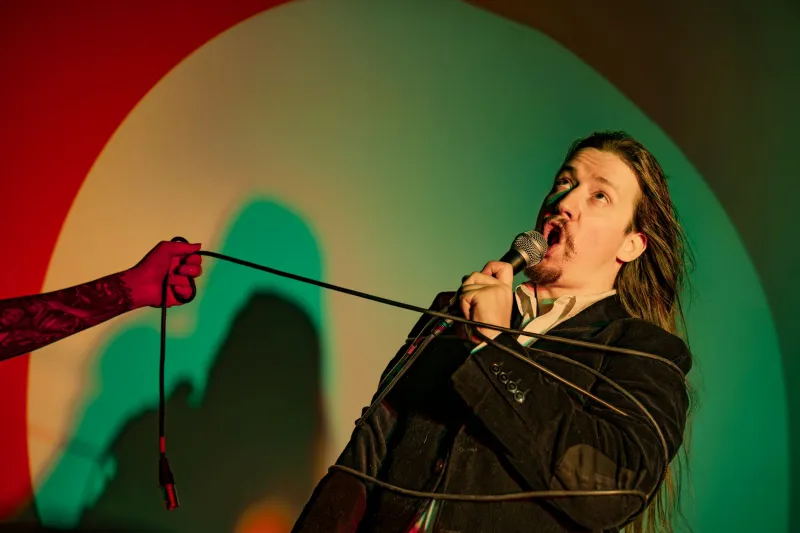
There's a moment every great comedian knows. It's not the punchline itself — it's the half-second of silence before the punchline lands. That tiny pocket of tension, that held breath in the audience, is the whole game. Ask any seasoned musician and they'll tell you the exact same thing about a rest in the music, a beat withheld just long enough to make the room physically ache for the drop.
Coincidence? Absolutely not.
Welcome to what we're calling the Comedy-Music Pipeline — the very real, surprisingly deep connection between the funniest humans on earth and the most musically intuitive ones. If you've ever wondered why so many comedians moonlight as musicians (or vice versa), buckle up, because this rabbit hole goes way deeper than you'd expect.
Your Brain on a Punchline (and a Bass Drop)
Neuroscience has been quietly doing the homework on this for years. When researchers study how the brain processes humor, they consistently find activation in areas tied to pattern recognition, prediction, and — here's the kicker — rhythm. The same neural networks that help you anticipate where a melody is going are hard at work when you're sensing that a comedian is winding up for a joke.
Dr. Robert Provine, a behavioral neuroscientist who spent years studying laughter, described humor as fundamentally a social rhythm — a call-and-response pattern between performer and audience. Sound familiar? That's literally what musicians call it too.
Both disciplines live and die by expectation management. Comedy sets up a pattern and then violates it in a satisfying way. Music does the same thing — establish a groove, break the groove, resolve the groove. Your brain releases dopamine in both cases. You laugh. You dance. You feel like the performer just read your mind.
Because, in a very real sense, they did.
Reading the Room Is a Superpower (And It's Learnable)
Ask any touring comedian what separates a good night from a great night and they won't say material. They'll say the room. A Tuesday crowd in Omaha hits differently than a Saturday crowd in Brooklyn, and the performers who can feel that shift — and adjust in real time — are the ones who build careers.
Musicians talk about this constantly too. Veteran performers describe "playing to the energy" of a venue, sensing when a crowd wants to move versus when they want to sit back and absorb. It's not telepathy. It's hyperawareness of micro-signals: body language, noise levels, the collective exhale of an audience settling into a groove.
Comedian and multi-instrumentalist Reggie Watts — who famously blends beatboxing, looping, and abstract stand-up into something that defies every category — has talked about this in interviews. He describes his performance style as essentially improvised music where the "notes" happen to be concepts and absurdist observations. The rhythm is everything. When the rhythm is right, the laughs come naturally. When it's off, no amount of clever wordplay rescues the set.
"Timing isn't something you add to a joke," Watts has said in various forms across interviews. "It IS the joke."
Swap the word "joke" for "song" and you've got a quote that would fit in any music documentary ever made.
The Performers Who Live in Both Worlds
The crossover list is longer than most people realize. Donald Glover — Childish Gambino to the music world — built his foundation in comedy writing for 30 Rock before becoming one of the most critically acclaimed recording artists of his generation. His music has always had a comedian's sense of subverted expectation, building emotional setups that pay off in ways you didn't see coming.
Then there's Bo Burnham, who started posting musical comedy songs on YouTube as a teenager and eventually created Inside, a Netflix special that functioned more like an experimental album than a traditional comedy show. The whole thing was constructed around musical tension and release. The jokes landed because the music set them up.
Even going back further — Steve Martin was a serious banjo player long before he was a household name as a comedian. He's been open about the fact that learning bluegrass taught him more about performance pacing than any comedy class ever could.
The through-line in all of these careers? Every single one of them developed an almost obsessive sensitivity to timing, tone, and audience energy. The stage — whether it had a mic stand or a drum kit — was always just a different instrument for the same fundamental skill.
How to Develop Your Own Pipeline
Here's the good news for aspiring entertainers reading this from Ronnieland: this stuff isn't reserved for once-in-a-generation talents. The core skills are genuinely trainable.
Listen to live recordings obsessively. Not just for content, but for the spaces. Notice where comedians pause. Notice where musicians let silence breathe. Start mapping those moments and you'll start hearing the shared grammar underneath both art forms.
Try improv comedy if you're a musician. Improv theater is basically jazz for non-musicians. You're learning to read a room, respond in real time, and trust your instincts over your rehearsed material. Every musician who has tried improv comedy reports the same thing: it made them a better bandleader.
Try playing an instrument if you're a comedian. Even casually. Even badly. Learning to feel rhythm in your body — actually internalizing a beat rather than just intellectually understanding it — changes how you experience time on stage. Your pauses will get more intentional. Your callbacks will land harder.
Record yourself performing and watch it back without audio. Seriously. Mute your own performance and watch your body language, your pacing, your physical rhythm. What you see will tell you more about your timing than any note-taking ever could.
The Room Always Knows
At the end of the day, whether you're killing at an open mic or dropping a new track on SoundCloud, the audience is always the final judge. And audiences — even ones that couldn't explain why — respond to the same fundamental thing: a performer who is genuinely, completely present with them in that moment.
That presence is what comedy and music are both chasing. It's what makes a crowd lean forward instead of checking their phones. It's what turns a performance into a shared experience that people talk about on the drive home.
So the next time someone tells you to "stick to music" or "just focus on comedy," remember: the funniest people and the most musical people are working from the same blueprint. The pipeline is real, the overlap is deep, and the skills absolutely transfer.
Now go read the room. You've got this.