Somebody Else's Song, Your Whole Entire Soul: The Weird Magic of Covers That Hit Different
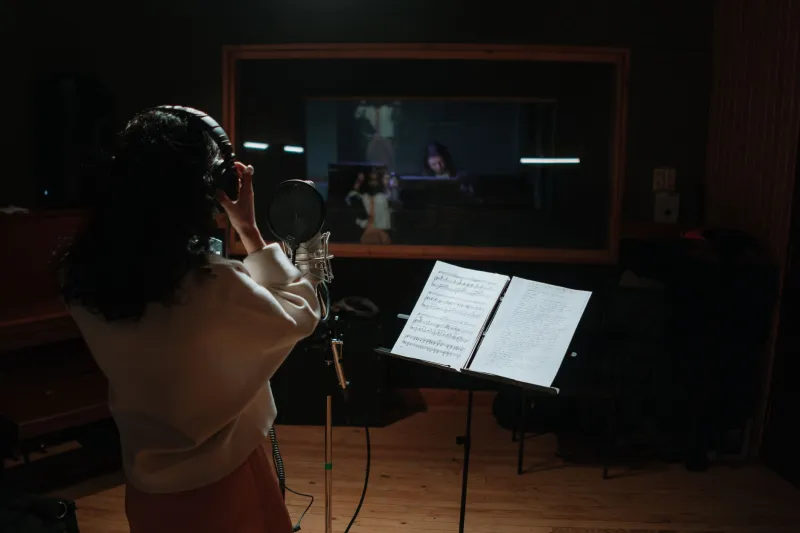
Here's a thing nobody tells you at open mics or in the comment sections of music YouTube: some of the most you music you will ever make will start with someone else's words, someone else's chord progression, and someone else's story. And yet, somehow, by the time you're done with it, it'll feel like you wrote it in your own blood at 2 a.m. on a Tuesday.
That's the remix effect. And it's one of the most fascinating paradoxes in the whole creative universe.
The Blank Page Is Actually Terrifying
Let's be honest for a second. Total creative freedom? Overrated. Genuinely terrifying, even. When you sit down to write something completely original, the possibilities are so enormous that your brain just... stalls. You've got infinite directions to go and somehow that means you go nowhere. It's the creative equivalent of standing in a massive grocery store and leaving with nothing because you couldn't decide.
But hand an artist a cover assignment — a specific song, a specific structure, a specific melody — and something shifts. Suddenly the question isn't what do I make? It's what do I do with this? That's a completely different creative muscle. And it turns out, that muscle is where a lot of artists actually live.
Constraints, counterintuitively, are fuel. They force you to make choices. And those choices? That's where your voice sneaks in.
The Evidence Is All Over Music History
Jimi Hendrix didn't write "All Along the Watchtower." Bob Dylan did. But ask most people under 40 which version they know, and Hendrix wins in a landslide. Why? Because Hendrix didn't cover the song so much as he inhabited it. He slowed it down, electrified it, bent the guitar until the notes sounded like they were in physical pain. The result was so distinct that Dylan himself reportedly started performing his own song more like Hendrix's version afterward. Let that sink in.
Or consider what Whitney Houston did to Dolly Parton's "I Will Always Love You." Dolly's original is a quiet, country goodbye — delicate, understated, bittersweet. Whitney's version is basically an emotional natural disaster. She turned a gentle farewell into a full-on operatic reckoning with love and loss. Same song. Completely different human being on the other end of it.
And it's not just the legends. Cover songs have launched careers at every level. Artists who spent years trying to get noticed with original material suddenly broke through by interpreting something familiar in an unfamiliar way — and in doing so, showed the world exactly who they were.
Why Constraints Unlock Authenticity
Psychologists who study creativity have a name for what happens when you work within limits: productive constraint. The idea is that boundaries force your brain to problem-solve in ways it wouldn't bother to when everything's on the table. You can't change the melody too much, so you focus on phrasing. You can't rewrite the lyrics, so you change the feeling behind them. You strip a pop song down to acoustic guitar and suddenly the emotional core of it is sitting there, naked and exposed, and you have to figure out what to do with that.
What you do with it reveals everything.
In comedy, this same principle plays out constantly. Sketch writers who are given a specific character, a specific premise, a specific format — they often produce their sharpest work. The improv rule of "yes, and" works because it forces you to build on what's already there rather than blowing everything up and starting over. The structure is the gift. The limitation is the invitation.
Covers as Emotional Archaeology
There's another layer here that doesn't get talked about enough: when you cover a song, you're also excavating your own relationship to it. Why did you pick this song? What does it mean to you? What part of it hits different when you sing it versus when you just hear it?
That process of selection and interpretation is inherently autobiographical. You are, whether you realize it or not, telling the audience something about yourself the moment you choose the song. And then you're telling them more with every creative decision you make from there — the tempo, the key, the emotional register, what you lean into and what you pull back from.
Some artists have figured out that covering songs is actually one of the fastest ways to communicate who they are to a new audience. It's like a shortcut to intimacy. The listener already knows the song, so they're not spending energy decoding unfamiliar material. They're free to just watch what the artist does with something familiar. And that's where personality, taste, and genuine artistry get to shine without the noise.
What This Means for Your Creative Life
Whether you're a musician, a comedian, a content creator, or just someone who makes things in whatever form that takes — the lesson here is worth borrowing.
Stop waiting for the perfectly original idea to descend from the heavens. Start with something that exists. Riff on it. Reinterpret it. Put it through the filter of your specific perspective and your specific life experience and see what comes out the other side.
Write a parody. Cover a classic. Do a genre-swap. Take a pop banger and play it slow. Take a ballad and make it bounce. Do the thing that makes the purists uncomfortable.
Because here's what the remix effect is really telling us: authenticity isn't always born in a vacuum. Sometimes it's born in conversation — with another artist's work, with a tradition, with a sound that came before you. Your voice doesn't have to be built from scratch. It can be discovered in the act of translation.
And honestly? That might be the most original thing you ever do.
Welcome to Ronnieland — where the music hits different and the creative conversations never stop. Drop your favorite cover-that-went-harder-than-the-original in the comments. We've got time.