Your Brain Remembers the Comedian But Ghosted the Playlist: Here's the Neuroscience Behind That
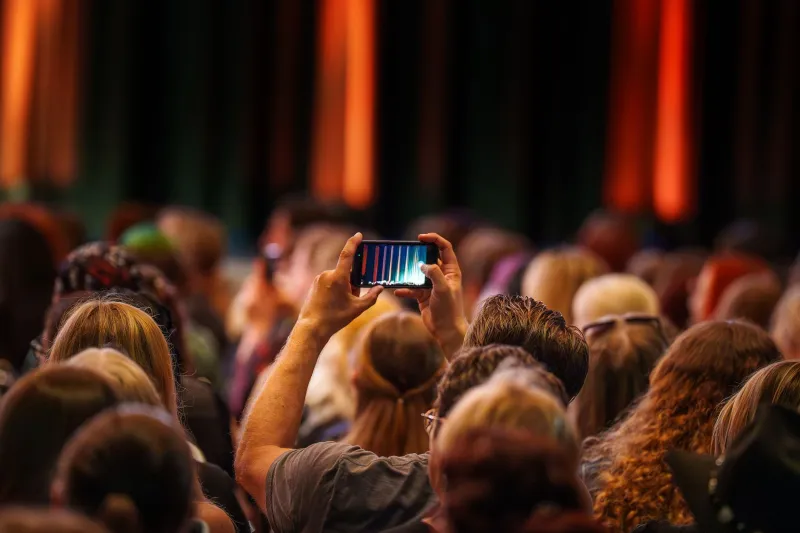
Close your eyes for a second. Think about the last live comedy show you went to. Odds are you can remember specific jokes, the way the comedian moved across the stage, maybe even what you were drinking when the punchline hit. You might remember laughing so hard your face hurt. You might remember turning to whoever was next to you and making eye contact in that shared "did they really just say that" way.
Now think about the last playlist you had on in the background while you were doing something else. What was the third song? What was the vibe? Was it even good?
...Yeah. Exactly.
This isn't about music being less valuable than comedy. It's about how your brain decides what's worth keeping — and in 2024, the gap between what sticks and what evaporates is telling us something important about attention, memory, and what it actually means to connect with an audience.
The Memory Factory in Your Head Has a Hiring Policy
Your brain doesn't store everything equally. That would be wildly inefficient. Instead, it runs a constant triage operation, deciding in real time which experiences are worth encoding into long-term memory and which ones get filed under "fine, whatever."
The main factors that trigger deep encoding? Novelty, emotional intensity, social context, and unpredictability. Your hippocampus — the part of your brain most responsible for forming memories — essentially lights up when something unexpected or emotionally charged happens. It's an evolutionary feature. Surprises used to mean either danger or opportunity, so your brain learned to pay close attention to them.
Live comedy hits almost every single one of those triggers simultaneously.
A good comedian is, by design, unpredictable. You don't know where the bit is going. You don't know when the punchline is coming, and if you do know, a great comic will subvert your expectation anyway. The physical presence of another human being in the room activates your mirror neurons — you're not just watching someone be funny, you're experiencing funniness in a socially shared space. The laughter around you amplifies your own response. Your body is involved. You're leaning forward, covering your mouth, grabbing someone's arm.
That's not passive entertainment. That's a full neurological event.
Streaming Is Comfortable, Which Is Exactly the Problem
Now let's talk about what happens when you hit shuffle on Spotify while you're folding laundry.
The music is good. Maybe it's great. But your brain has categorized the situation as low-stakes and familiar. There's no unpredictability — you know roughly what genre you're in, you know songs won't suddenly do something that requires your full attention, and there's no social element demanding a response from you. Your brain, recognizing that nothing urgent is happening, essentially puts memory encoding on the back burner.
This is called "passive consumption," and it's the dominant mode of music listening in 2024. According to data from multiple streaming platforms, the average listener has music playing for several hours a day — but a significant chunk of that listening happens as background to other activities. The songs are present. The experience is not.
Neuroscientists refer to this as "inattentional amnesia" — not quite forgetting, but never really registering in the first place. The music moved through you without leaving a mark.
What Live Music Gets Right That Streaming Can't
Before musicians feel too attacked — here's the important nuance. The issue isn't music itself. The issue is the context of consumption.
Live music, when it's done right, hits the same neurological triggers as comedy. A concert where you don't know the setlist, where the artist improvises, where the crowd energy is unpredictable, where you're physically present and emotionally invested — that creates the same kind of durable memories as a great stand-up set. Ask anyone who's seen their favorite artist live. They remember exactly where they were standing during that one song.
The difference is that music has been more thoroughly industrialized into background-friendly formats. Playlists are designed for frictionless listening. Algorithms serve you songs that match your mood rather than challenge it. The whole streaming architecture is optimized for comfort, not for the kind of memorable friction that makes your hippocampus take notes.
Comedy, by contrast, has never really been successfully domesticated into passive content. Even a comedy special on Netflix requires your attention in a way that a playlist doesn't. You have to watch. You have to track the setup. You have to be present for the payoff.
What Entertainers Can Actually Do With This
If you're building an audience in 2024 — whether you're a comedian, a musician, or some glorious hybrid of both — this neuroscience has real practical implications.
First: create moments of unpredictability. Audiences remember what surprised them. The song that suddenly shifted tempo. The bit that went somewhere completely unexpected. The live performance where something went "wrong" and the artist handled it in a way nobody saw coming. Build for those moments intentionally.
Second: make the body involved. Memory encodes more deeply when the physical experience is part of it. This is why a concert feels different from a playlist, and why a live show feels different from watching a special at home. If you can get your audience moving, reacting physically, or socially engaged with the people around them, you're stacking the deck in favor of a lasting impression.
Third: stop optimizing purely for convenience. The most streamable, most algorithmically friendly version of your content is often the least memorable version. There's a time and place for accessibility, but if your entire output is designed to slide effortlessly into someone's background, don't be surprised when it disappears just as effortlessly.
Your audience's brain is keeping score. Make sure you're giving it something worth the ink.